In it, he proposes that an organization of any significant scale cannot be understood through the typical approach of functional decomposition. Instead, Beer suggests examining living systems in order to better understand how the form, functions, fitness, and interactions of their parts contribute to the purposes and fitness of the system as a whole. He argues that in the absence of meaningful adaptive control, bureaucracy emerges from the logic of collective action over time.
Beer's later works followed on this theme and developed it further. In particular, Diagnosing the System for Organizations provides a more succinct summary of an underlying method to deploy his ideas, while in The Brain of the System, he dives more into the theory behind these methods. Both build upon his work on Operations Research, and his book, "Decision and Control" (a lost art except in production control situations).
Recursion
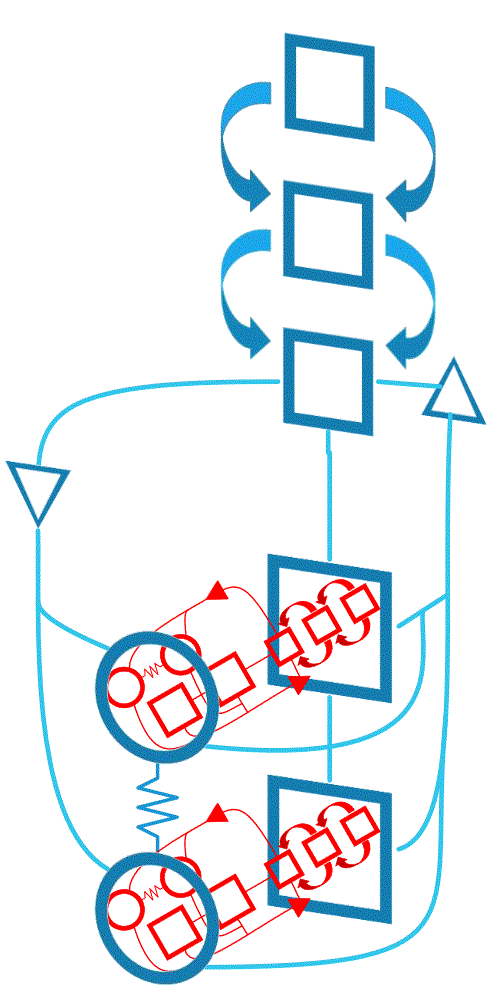
In The Brain of the System, Beer spends quite a bit of time explaining Figure 1, one of many diagrams which he uses to explain his notion of a viable system. Each such system is grounded in recursion, or as Beer says, "Every viable system contains viable systems and is contained in a viable system." One of his students recovered an audio recording from one of his lectures in 1990 (part 1 and part 2) on Intelligent Organizations. These lectures provide a good overview of both books and are worth sampling before committing the time it takes to digest the books themselves.
Figure 1
Beer uses Figure 1 as a notational metalanguage to describe the minimum orientations necessary for effective organizational design. In this notation, operations are depicted as circles, a control hierarchy (aka management) is portrayed using squares, and governance is represented by triangles. If you examine this figure, you can see that recursion (in which each immediately lower level contains all the levels below it), and all can be subsumed in a higher aggregation. This enables his model to be self-referencing, which characterizes situations in which each part makes sense precisely in terms of the other parts.
This means the whole cannot be completely defined by the parts themselves, but rather by their interactions. This complexity and associated unknowns of the associated activities, despite best efforts, is what makes planning and tracking tasks themselves complex. Such systems also are susceptible to oscillation, a phenomenon demonstrated in systems thinking workshops that employ devices like the Beer Distribution Game.
Beer introduces this metalanguage and its associated concepts gradually, relating each to the structures and functions of the brain and nervous systems, and observations about their design and behaviors. He suggests the overall purpose of a living system is survival of its species, rather than of a particular individual, which may be unsettling for selected agents. His notion of survival involves retaining identity as an independent entity over extended periods, since survival requires adaptation to environmental changes; he expects the forces of fitness for use, learning, adaptation, and creative destruction will shape the situation at any point over this journey. Though he doesn't quote Galileo Galilei directly, his argument rests on a principal Galileo first stated as "Nature... doth not that by many things, which may be done by few."
Beer goes on to directly confront the underlying constraints encountered by most reorganizations - their fuzzy scope, political gaming, periods of uncertainty, and cultural resistance to change. He also relates the goal of survival to a firm’s need to protect its ‘seed corn’ and the need to optimize its transfer functions to improve its performance over time; in other words, transformational operations cannot consume all available resources for itself.
His depiction of how hierarchical structures, intelligently designed, enable efficiencies in searching for solutions, and mirrors a pattern recently noticed elsewhere, such as in an MIT article relating the physics of the fabric of the universe, and in recent breakthroughs in machine learning. The shortest path for reducing uncertainty to its minimum size involves uses of binary chop algorithms to evaluate binary classifiers for recognition, selection, and decisions.
Fjgure 2
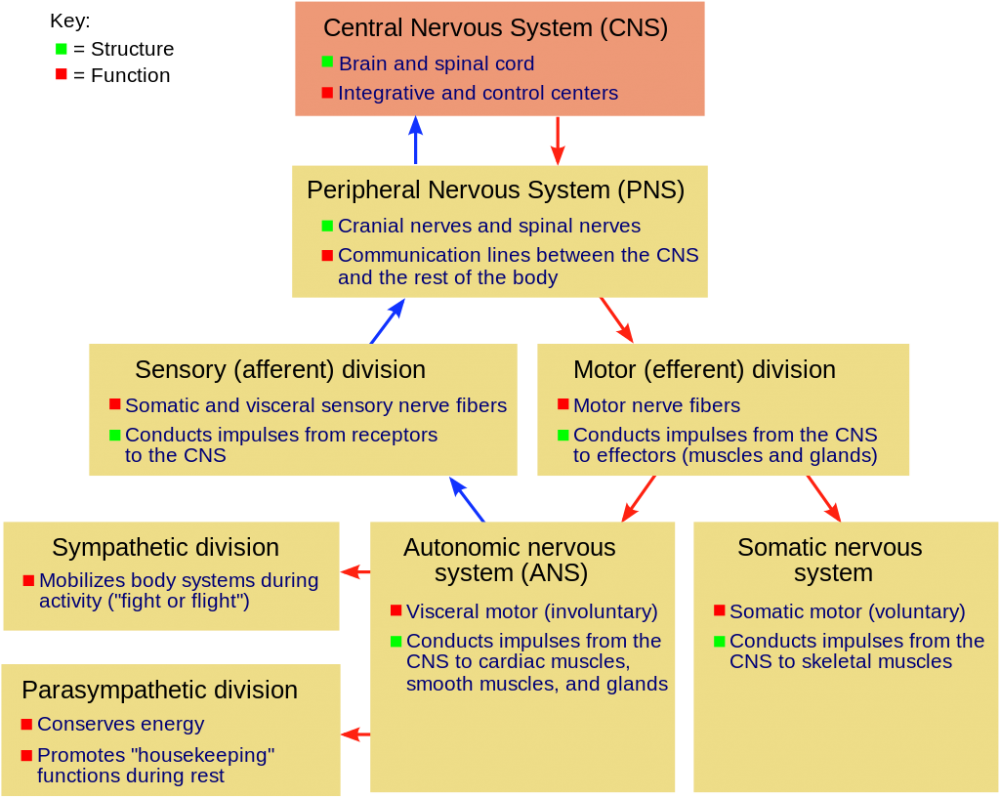
Stanford argues for the design of a control system for organizations involving a focus on inputs that are optimally converted to outputs, and in which sensors, transforms, and redundancy are used to offset noisy communications channels, limited bandwidth, and communications latencies. He notes that our own central and peripheral nervous systems (see Figure 2) are a mixture of such central and distributed control.
He suggests his principles are applicable to smaller organizations, entire firms, and even societies, and even attempted this computationally with far less computing power than a single desktop offers today. He introduces a useful term (the 'system of study') which is like the architectural concept of a system of interest, and which he uses to place observers in a variety of hierarchical contexts. This reorienting frame of reference allows one to 'zoom in and out'; there is always a higher authority, and there is always a changing environment, all the way down.
He argues that in this progressive descent, each system of interest must autonomously strive to achieve homeostasis, a stable, self-regulating state of balance within its internal environment (interfacing with its peer organizations) while adapting to the external environment (where it has kinship with its peers):
It is necessary that large areas of any such complex organization should in fact be autonomous. If every aspect of the business, every smallest decision, had to be thought about consciously at the senior management level, then the firm would grind to a halt rather quickly. It is the same in the body and the same reasons apply. Both systems operate autonomic control, which is to say a level of management which does not involve conscious direction by the organism as a whole.
From the point of view of the whole organism, whether body or firm, the autonomic function is essentially to maintain a stable internal environment. This idea, called "homeostasis', really is necessary in any viable system. Neither brain nor board could press on with prosecuting a deliberate policy if the internal organs were running amuck. The well-ordered production machinery must not overheat, whether in terms of men or machines; cost and quality must be kept within physiological limits, which is to say that they must vary within a range narrow enough for the health of the whole organism to tolerate; and stocks of inter-process materials must be kept small enough to avoid idle time. The company board expects that its internal management can cope with these matters, and the conscious part of the brain expects the same mutatis mutandis of its autonomic nervous system.
Design issues
He starts his exposition on designing organizations by cataloging the problems most businesses face, and by poking holes in conceptual schemes:
The primitive act in all conceptual schemes for choosing sets is the simple, finite act of enumeration - we "set" them down as it were. We may do this by actually producing all the members of the set for inspection, as a chess set or a set of teeth. Usually, however, we specify a set of names, which is taken to represent some set of "things". We rarely enumerate the collections for any which forms the conceptual basis for our thinking. Enumeration, which forms the conceptual basis for the other operations, has perils of its own, but these are as naught compared with the possibilities for mischief in derived methods.
and heuristics:
We have a scale of ascending values for heuristicdevices, depending on how far you go before you must stop. Going from the narrow to the broad, we find ideas, concepts, rules, principles, laws, reality, and truth. The further along this scale, the less we notice that a heuristic device is a device.
The nastiest of these methods is the representation of a set by a typical member. This method rests on the assumption that the set can be typified, an idea that goes back at least to Plato. Platonists argued that the ideal type is a better representation of the set than any enumeration could be, since the actual members of a set could at best be faulty realizations of the ideal type. The ideal type, however, is strictly an observer's mental construction, which may be a useful way to summarize a mass of data, but as taxonomists have discovered, it may simply be the path to a decomposition fallacy.
Beer also argues that oversight has limits:
If I want you to know in complete detail what I have been doing for the last hour, then I shall want exactly one further hour to explain. If I have ten colleagues, and cannot see on average more than two of them at once, then I shall need five hours to explain my one hour. It is just the law of requisite variety. If can afford no more than ten minutes in explaining myself for every hour worked, then I shall devote two minutes per colleague, and there will be a ratio of 30:1 in the reduction of variety between myself and them. Some lethargic managerial societies seem to work quite smoothly on this basis, for the very simple reason that for them this turns out to be also the ratio of clock time to useful working activity. But a man who really is doing an hour's work in every hour bound to lose in intelligibility.
Next, we must note that this applies in the best of all worlds - one in which people love each other, and are completely determined to share their understanding. But human nature is not like this. Even the most willing of us find himself antipathetic, in varying degrees, to some of his colleagues. Even the most innocent of us occasionally succumbs to political motives which make him a deliberately poor communicator.
The conservatively minded business men among us will have none of this somewhat ruthless analysis. There is no need, for goodness sake, for me to tell everyone else in detail what i am doing. I am paid my job properly and all that anyone to needs to know is what I think they ought to know about the results of my work. And yet this is just the trouble. A viable organism works as an integral whole. A typical business is integrated too late, and too little.
and being mindful of innovation dilemmas:
Adventurous ideas soon become constrained by the observed fact that their proponents cannot think them through to a proper conclusion, it would seem, and the old ideas prevail. It is not because they are successful: they are not, and the world is in a worse mess to prove it.
The first reason as to why adventurous ideas often fail, and old ideas prevail is benign. It reflects merely on human weakness and inadequacy. It is not a theory of conspiracy, which declares that sinister forces are mustered against any kind of innovation. And yet there is a malign explanation as well... The word malign means simply inimical to viability. We do not have to be paranoid to recognize that we are actually ill.
The second explanation says that the new idea is not only beyond the comprehension of the existing system, but that the existing system finds it threatening to its own status quo. Of course it does. That is not necessarily because of its determination to hang on to power, although that is often a factor. It is mainly because the existing system does not know what will happen if the new idea is embraced.
The first explanation said that the innovator fails to work through the systemic consequences of the new idea. The second explanation says that the Establishment cannot either, and with better reason and, what is more, that it has no incentive whatsoever to do so. It was not its own idea for heaven’s sake. The onus is on the innovator. That seems perfectly reasonable, until we remember the power equation: it turns out that the Establishment controls the resources that the adventurous idea needs.
Too often, he argues, such new gloss - call it the new miracle technology - on old ideas:
It is against this background that management confronts the electronic computer. This instrument offers management its own technology B, something which makes the managerial world utterly different. But management has addressed itself to the possibilities in a way which virtually precludes the emergence of a new managerial order. It has tried instead to assimilate the computer into managerial technology A - improving, or let us say simply souping-up, the ways of regulating matters with which managers are already familiar.
What could they really be expected to do? This question was answered according to temperament, but many managers suspected two things. Computers might turn out to be incomprehensible to the manager himself, and therefore a substantial personal threat; in any case, the cost might be ruinous. But the good manager is made of sterner stuff than this. In the second stage he very properly came to grips with the nature of the machine and made a serious effort to understand its basic method of operation. He soon found out that the machine is a moron. Not only did this discovery remove unjustifiable fears, but it took away all sense of wonder, and that was a pity.
Although present-day computers fall very far short of the human brain in many capabilities, they are in just as many ways very much superior to the computers in our skulls. But in this second phase people lost sight of the fact they fell to discussing rather trivial problems about the relation between and consulting office machines and scientific machines in terms, for example, of the input/output requirement. Thus the managerial issues rapidly became political, because people used these trivial arguments to justify different computers in the office and the research laboratory, and a different computer again in the production context. Anything which inflames the appetite for empire building not only becomes a vice, but detracts from the issues which ought to be discussed.
For the manager, this was to be the age of electronic data processing referred to by the slick acronym EDP. Regardless of the purposes to which processed data would be put, all effort was now focused on the argument whether more and better data could be provided faster and more cheaply by installing a computer or by streamlining orthodox clerical procedures. This done (and of course this is a process that still goes on) some managers decided to go ahead and install computers. And that brought us to the third phase, in which most businesses remain. There is a rather widespread use of computers in the role of new lamps for old. Routine office work is done by machines; sometimes staff have been saved, sometimes not. More and better output has been obtained; sometimes people have known how to make use of it, and sometimes not. A variety of benefits has been sought; sometimes money has been saved, but all too often the pay-off has been negligible. Many who introduced computers during phase two became disappointed in phase three while many who did not came to feel that they were well out of it.
Generally, these evangelized miracles have limitations that constrain realizable benefits, leaving those who chased a particular technology epoch stuck with the bill. This phenomenon is similar to ownership of units in a condominium which may be stuck with escalating costs, should the property developer be unable to sell enough units of the units, leaving a fraction of the people stuck with paying for all of the support and maintenance.
Beer then introduces his viable system model for organizations, and his representation of a theory of viable systems, which each share the collective purpose of survival, even at the expense of their individual elements. Firms, he suggests, are such constructs. Adaptability is crucial to their survival over the long term, and this is an essential characteristic of their design. Yet the anatomy of management limits the attention paid to each part of the organization. Because of variety, one of his foundational arguments, and a measure of the complexity of the interactions in the system, the absence of a learning model such as pattern recognition requires excess and unnecessary variety. This leads to the combinatorial explosion of states across all parts of a system, which are impractical to even count, though their ideal state is captured by Ashby's Law of Requisite Variety. Despite this complexity, each part may still be comparable with others to rank which have more variety than others, and through feedback, determine whether signal attenuation or amplification is required.
He uses the triggering and responses of an organism as an analogy, as it responds to situations through a set of voluntary and involuntary actions. Vertebrate species employ sensing, cognition, decisions, and action using the pathways of the central nervous system, which includes the brain, spinal cord, and peripheral nervous system, to connect it to every other part of the body. The peripheral system is, in fact, a system of systems, which consist of:
The primary function of the central nervous system is to send signals from one cell to another, and through that mechanism, from one part of the body to another, with feedback on the results. Both the autonomic and enteric nervous system function involuntarily, whereas the somatic nervous system controls the muscles to make voluntary movements and provide the reflex arcs of the body's neural pathways. Signals travel over separate pathways depending upon which direction information is being sent; those sent from the brain pass over efferent nerves, while information transmitted to the brain from the body is transmitted over afferent nerves. Signal transport itself is performed by special cells called neurons, in waves passing over thin fibers called axons, and using signals generated by electrochemistry.
Signal modulation
Each junction, or synapse, excites, inhibits, or modulates these signals, providing either amplification or attenuation. Collectively, these subsystems form circuits and neural networks that form an organism's perception of the world.
An algorithm is a technique, or a mechanism, which prescribes how to reach a fully specified goal. A typical air pilot's flight plan is an algorithm. The instruction: turn left at the crossroads, take the second turning on the right, turn left at the Red Lion and our house is 120 yards up on the right' is an algorithm. A method for finding the square root is an algorithm, and so is a computer program. This last is important, because we shall soon have to clear up some confusion about the capabilities of computers. A computer can do only what it is precisely told to do. The programmer has to write an algorithm, then, which will exactly determine the computer's next move in any set of circumstances whatever.
An heuristic specifies a method of behaving which will tend towards a goal which cannot be precisely specified because we know what it is but not where it is. Suppose you are trying to reach the peak of a conical mountain enveloped in a cloud. It must have a highest point, but you do not know the compass bearing. The instruction: "keep going up' will get you there, wherever ‘there' is. ‘Take care of the pence and the pounds will look after themselves' is an attempted heuristic for "being wealthy". Heuristics prescribe general rules for reaching general goals, and do not typically prescribe an exact route to a located goal as does an algorithm. There are after all an infinite number of paths up the mountain, and it does not matter much which path is taken (although some routes may be quicker than others).
These two techniques for organizing control in a system of proliferating variety are really rather dissimilar. The strange thing is that we tend to live our lives by heuristics, and to try and control them by algorithms. Our general endeavor is to survive, yet we specify in detail... how to get to this unspecified and unspecifiable goal. We certainly need these algorithms, in order to live coherently; but we also need heuristics and we are rarely conscious of them. This is because our education is planned around detailed analysis: we do not really understand things unless we can specify their infrastructure. The point came up before in the discussion of transfer functions, and now it comes up again in connection with goals. "Know where you are going, and organize to get there' could be the motto foisted onto us and on to our firms. And yet we cannot know the future, we have only rough ideas as to what we or our firms want, and we do not understand our environment well enough to manipulate events with certitude.
Birds evolved from reptiles, it seems. Did a representative body of lizards pass a resolution to fly? lf so, by what means could the lizards have organized their genetic variety to grow wings? One has only to say such things to recognize them as ridiculous, but the birds are flying this evening outside my window.
If the goal is not recognized in detail, an heuristic is required, so the computer must be supplied with an algorithm determining an heuristic. That is a basic trick. Suppose we say: ‘The computer must learn from its own experience, as do we ourselves.' Learn what? We do not know; what we meant was that the computer must find out over a period, by trial and error, the courses of action which lead to better results of control. We shall say what is a better and what a worse result, but the computer has to determine a better strategy, a better control system, than we ourselves know. And of course it can do it. Because its algorithm, what it is programmed to do, specifies an heuristic. Alter the solution you are now using a little bit, says the algorithm, and compare the outcome with the erstwhile outcome. If this is more profitable, or whatever else we say, adopt it. Go on like this until variation you make leads to a worse result than you already have. Then any you may hang on to this solution, until the situation changes; whereupon you may do better once again by producing a new variation.
This example could be continued indefinitely. The point is that heuristic techniques are determined within a framework specifying the mode, the limits, and the criteria of search. And if that framework is itself an heuristic, then it too requires a framework; and so on indefinitely. At some point the nth framework must be reached which, from this system's internal standpoint at least, will have to be declared an absolute framework. In good logic, this cannot be done; but in all practice it has to be done. Hence all finite systems are limited and incomplete. We ourselves, our firms, our economies all suffer from this limitation. And because we do, the best possibility for change directed towards ever more successful adaptation lies in a reorganization of these hierarchies of command.
He strives to dampen oscillations, accommodate limitations in information exchanges over channels, and reinforce the accountability of agents. The individual 'systems' are conceptualized as multinodes which he paints as elaborate functioning collections of unreliable elements interoperating to deliver results.
At each level in such sense and respond systems, a basic set of decision elements must be attended to:
It is interesting to begin the analysis of hierarchical control structures by asking about the basic decision elements of which ranks and orders of command are in general composed. In nature, if we consider that most sophisticated control system, the brain, this element might be identified as a single nerve cell or neuron. In industry or government indeed in any strongly cohesive social group the element is some sort of manager.
Both the neuron and the manager have one really basic task to perform: to decide. In the neuron's case, a pulse must either be triggered down the output nerve or not. For the manager, the fundamental task is also to say yes or no. It true that managers do not spend their lives uttering these two words; they may never utter them. None the less, this is their task, and the subtleties, the nuances, the might-I-suggests and the perhaps-you-woulds are really socially intricate ways of saying yes or no.
In order to reach a binary decision, the decision element has to establish a threshold of decision. We may think of it as saying 0 until it is prompted to say 1 instead. This would be a permissive kind of management, in which the decision element does nothing until activated. It must not be activated by any stray impulse or noisiness that happens to be floating around the system, and this fact establishes the need for a threshold. Over-sensitive neurons would soon send either men or firms mad. When things really begin to happen, the decision element accumulates its evidence. When it is sure that there is real evidence demanding action, which is to say when the sum of inputs exceeds a threshold value, it fires.
This doesn't mean organic systems are perfect. Malfunctions arise because of genetic defects, physical damage, infection, and age; each of these has their complements in dysfunctional organizational behaviors. Our bodies protect against such malfunctions by redundancy and resiliency. For example, brains are amazingly capable of re-purposing components to bilateral functions when needed. However, as argued elsewhere, 'thinking fast and slow' mechanisms act differently, and are wired differently, with ramifications that must be factored into the effective design of systems.
Effective multi-level control
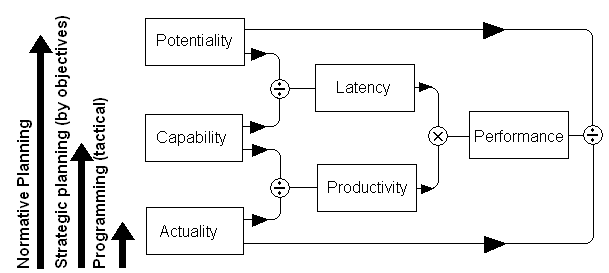
Beer suggests an alternative measurement approach that relies upon a multi-level structure to inject adjustments which will counter oscillations, tune performance, and provide for the greatest utility. These measures are depicted in Figure 3, and described here:
The dynamics of this whole structure depend on the quantification of its performance. Hitherto business has used the measure of money and price, the direction and rate of cash flow. Thus we have come to the quantification of business activity, in the corporations we know, the cost-accounting function. This is because cost accountancy provide lingua franca by which the disparate activities of unlike divisions may compared and aggregated. There is no reason why this should be so, beyond its historicity and (alleged) familiarity.
Figure 3
Divisional performance is about both short-and long-term viability. The notion that cost should be minimized or profit maximized within a fixed epoch leaves right out of the count other factors which are vital to the future viability of the business contained within the division. They are the latent capabilities of the firm, which may be built up and metabolized by wise management, or squandered recklessly by stupid management, without in either case procuring a change which is reflected in costings. For costings are short-term control instruments, and will not detect the mismanagement of latent resources. By definition, this mismanagement will not be detected until it is too late.
We need a measure of achievement which is both less 'loaded’, in terms of profits, and which is more comprehensive, in terms of the real resources at risk. If money is not the unit, then we must think in terms of pure numbers. There is a classic measure of productivity which can be extended. It expresses the ratio of what is possible to what is actual. Now we may deal with the problem of incorporating latent resources by a slight elaboration of this theme, which requires us to define three (rather than two) levels of achievement. They are:
actuality: This is simply what we are managing to do now, with existing resources, under existing constraints.
capability: This is what we could be doing (still right now) with existing resources, under existing constraints, if we really worked at it.
potentiality: This is what we ought to be doing by developing our resources and removing constraints, although still operating within the bounds of what is already known to be feasible..
There can be no argument about the numbers used to measure actuality. There will be severe arguments about the other two sets of numbers. But if we use good operational research it becomes possible to gain agreement that the numbers used are sensible and the process of investigation and discussion is itself highly beneficial. What matters is that capability and potentiality measures, though somewhat arbitrarily fixed, cannot then be arbitrarily changed. Hence although the absolute values of the productivity and latency indices provide only approximate assessments, movements of these indices over time provide the information that we really need.
Now of course we may project our future plans on the basis of any one of these notions of achievement, or indeed have three sets of plans which employ these three criteria. Planning on the basis of actuality I call programming. Planning on the basis of capability I call planning by objectives. Planning on the basis of potentiality I call normative planning. The first of these is simply a program because it accepts the inevitable shortcomings of the situation, and does not admit that anything can imminently be done about them. Programming is a tactical ruse. We move to genuine planning only when we set new objectives and try to achieve them. This is the strategic planning level.
Normative planning sets potentiality as its target and incurs major risks and penalties, although it also offers major and perhaps decisive benefits. But, however we plan, what really matures is always called actuality, and the measures of achievement proposed relate capability and potentiality to whatever may be actual at the time. Here are some more definitions:
productivity: the ratio of actuality and capability;
latency: the ratio of capability and potentiality
performance: both the ratio of actuality and potentiality, and also the product of latency and productivity.
Potentiality is always better than capability, which is always better than actuality. But if we are talking about profit, for example, 'better' means 'more', whereas if we talk about the number of men required to do a job, 'better' means 'less'. Consider, then , the question of what happens to the achievement indices when we go on doing what we have always done when the ultimate possibilities remain the same. This it may do by undertaking work study of processes, negotiating new agreements with the unions, raising the morale or improving the quality of managers, and so forth. What happens is that the latency measure improves (because capability is approaching potentiality) and productivity is lowered. But if potent management can in these circumstances improve the actual performance, as obviously it should, all three measures of achievement will rise.
The nodes of these systems of interest must be designed with the means to use such information, using what he calls algedonic feedback, in the form of alarms and triggers that cascade up through a command backplane anytime a request for information or reporting has timed out, fails to produce needed results, or exceeds the performance limits established in resource bargains which previously were struck.
Beer warns that without such a performance envelope, nodes or larger entities may end up competing with each other, rather than pulling together; at any scale, this quickly leads to an unstable overall system. Note that portions may still do well because of fitness to a particular set of circumstances, but may not be able to adapt to emerging circumstances:
The viable system is a system that survives. It coheres; it is integral. It is homeostatically balanced both internally and externally, but it has none the less mechanisms and opportunities to grow and to learn, to evolve and to adapt - to become more and more potent in its environment. In all of this the viable system may succeed sensationally, spectacularly fail or it may muddle along. The amoeba succeeded, the dinosaur failed, the coelacanth muddles along.
You and I have our own problems of survival. As to the firm, as to government, as to society, as to the future of mankind all viable systems we shall see. Structural change is so potent a business, and so traumatic to undergo, that people prefer to pretend they cannot see what their own eyes insistently report, rather than commit themselves to the re-shaping which is necessary.
Organizations cannot face up to more than a quarter of the reshaping that their long-term viability demands. This is of course the reason why so many enterprises are in a state of continuous, never mind continual, reorganization. People pretend that the great upheaval is almost complete: it never is, and the viable system becomes increasingly unstable as a result. This in turn makes every enterprise vulnerable to attack. When the management or the government has fallen, when its policies are in disarray and its people in despair, we can pretend no longer.
Figure 4
Beer is a critic of attempts to use computers as change agents; instead of clarity, he argues, such efforts often lead to information overload and measurement without control, which just produces waste and distraction. His insights have relevance to other general-purpose technologies, such as AI, as well:
It is against this background that management confronts the electronic computer. This instrument offers management its own “technology B”, something which makes the managerial world utterly different. But management has addressed itself to the possibilities in a way which virtually precludes the emergence of a new managerial order. It has tried instead tried to assimilate the computer into managerial technology A - improving, or let us say simply souping-up, the ways of regulating matters with which managers are already familiar.
What could they really be expected to do? This question was answered according to temperament, but many managers suspected two things. Computers might turn out to be incomprehensible to the manager himself, and therefore a substantial personal threat; in any case, the cost might be ruinous. But the good manager is made of sterner stuff than this. In the second stage he very properly came to grips with the nature of the machine, and made a serious effort to understand its basic method of operation. He soon found out that the machine is a moron. Not only did this discovery remove unjustifiable fears, but it took away all sense of wonder, and that was a pity.
Although present-day computers fall very far short of the human brain in many capabilities, they are in just as many ways very much superior to the computers in our skulls. But in this second phase people lost sight of the fact they fell to discussing rather trivial problems about the relation between and consulting office machines and scientific machines in terms, for example, of the input/output requirement. Thus the managerial issues rapidly became political, because people used these trivial arguments to justify different computers in the office and the research laboratory, and a different computer again in the production context. Anything which inflames the appetite for empire building not only becomes a vice, but detracts from the issues which ought to be discussed.
For the manager, this was to be the age of electronic data processing referred to by the slick acronym EDP. Regardless of the purposes to which processed data would be put, all effort was now focused on the argument whether more and better data could be provided faster and more cheaply by installing a computer or by streamlining orthodox clerical procedures. This done (and of course this is a process that still goes on) some managers decided to go ahead and install computers. And that brought us to the third phase, in which most businesses remain. There is a rather widespread use of computers in the role of new lamps for old. Routine office work is done by machines; sometimes staff have been saved, sometimes not. More and better output has been obtained; sometimes people have known how to make use of it, and sometimes not. A variety of benefits has been sought; sometimes money has been saved, but all too often the pay-off has been negligible. Many who introduced computers during phase two became disappointed in phase three while many who did not came to feel that they were well out of it.
Enough has happened in the computer world to demonstrate that these machines are now permanently with us. History has painfully demonstrated that once mankind knows how to perform a function by machine, the machine is in and man is out. And yet there is disappointment, and the economics of the whole business look somewhat rocky. The answer to the dilemma is becoming clear. Too many managers have been dazzled in EDP terms by the “more and quicker argument, with the result that little fresh thought has been given to the purposes which the information duly handled is supposed to serve. This... is management information. And so, the magic letters EDP are being replaced by the equally magic letters MIS, management information systems. This certainly appears to be another advance. It looks as if it takes seriously the question about the purposes of EDP.
But in reality, we become more and more embedded in managerial philosophies of the past. We continue to replace one thing by another which is indeed more effective, and now we have a great vision whereby all these bits and pieces will be integrated in a vast informational network. The whole firm will run on a basis of ‘instant fact’ because managers will draw any item of knowledge they require from a huge database into which all the facts about the business will be poured. I shall show explicitly why this vision of the future is actually incapable of fulfillment. The argument for the present rests on the fact that. even if these prognoses were reasonable, we should still have missed the point.
Items of fact about a business are profuse. They proliferate with every second that passes. Most of them are worthless in the sense that they have no bearing on managerial decision. By recording them, sorting them in different ways and printing out huge quantities of tables, nothing useful is accomplished. On the contrary, managers become engulfed in a sea of useless facts. Doubtless some valuable facts may be included, but if so they will be lost without trace. The manager wants information, not facts, and facts become information only when something is changed. The manager is the instrument of change (otherwise what is he doing?) which is to say his job is that of control. This means that the job is not to design a data-processing system at all, but to design a control system. And if we use the computer simply to undertake a souped-up version of the old kind of control system, which was inadequate simply because we did not have computers, we are no better off than before. It is the same with our planning techniques, which are part of the manager’s control armory, and which so desperately needs to be in the context of technological change. For again we are concentrating on ways of doing things rather than on what we do. What is the use of the ever-faster, ever-slicker, more nearly perfect implementation of rotten plans?
Even when measurements are intelligently designed, research indicates you'll only get what you measure, Worse, the measures will get gamed, leaving you worse than before.
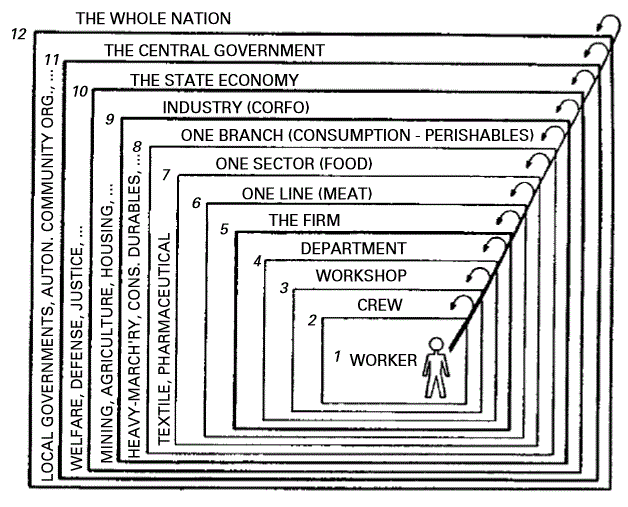
In roughly the last third of the book, Beer describes efforts to prototype these concepts in a decision support system for a state-run enterprise, which was launched during the presidency of Salvador Allende, who led Chile in the early 1970s. The endeavor, Project Cybersyn, had the goal of managing Chile's political system within their socialist framework that provided protections for the autonomy of workers, rather than imposing a smothering, top-down command-and-control system. He anticipated the failures of the Soviet system yet offered a model that would work at all the levels depicted in figure 4.
One of Beer's associates at the time was Fernando Flores, who would go on to become a pioneer in the field of artificial intelligence, along with Terry Winograd at Stanford; both have been at the forefront of progress in cognitive science over the last thirty years. Beer recognized that recursion was the only structure possible by which to manage the complexity necessary to sustain living systems and argued that the trends in increasing complexity would not end well unless appropriate shock absorbers were designed into these systems from the start.