

According to Coyne and Subramaniam1, a strategy is the handful of decisions that:
drives or shapes your subsequent actions over a planning horizon (typically multi-year)
are not easily changed once made, and
will have the greatest impact at this point in time on your long-term success
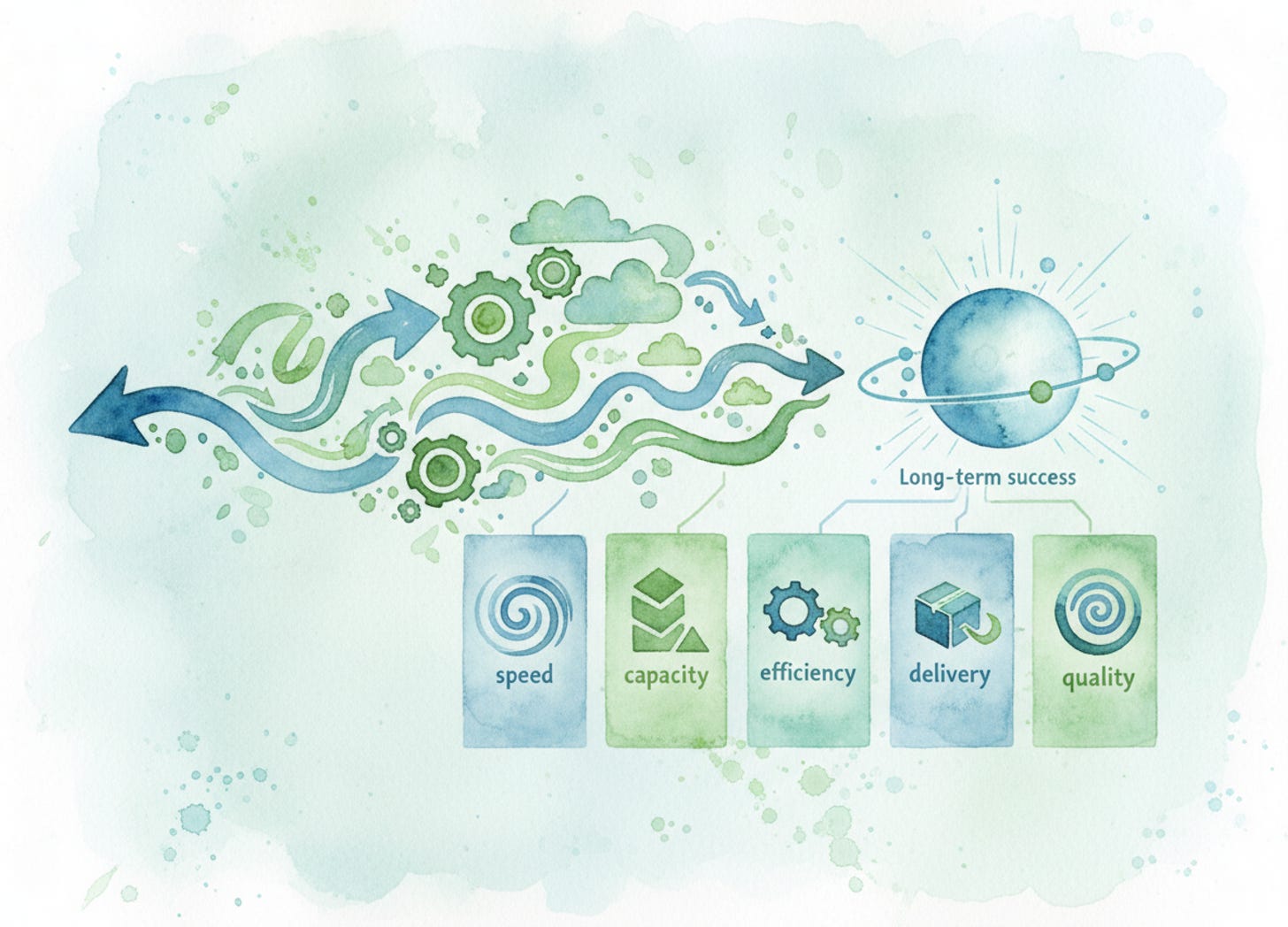
This handful of decisions includes:
selecting your strategic posture with respect to your customers for the products and services which you intend to offer them
identifying the value propositions which you will pursue with those customers through a coherent concept of operations
developing approaches to create or align projects with these sources of value
constructing tailored delivery systems to realize benefits from these projects as soon and broadly as possible
In synthesizing these strategies over time, customer-driven value should be pursued by extending:
Speed: the ability to deliver results faster than before, and respond rapidly to the emerging needs of the business
Approaches to quickly and successfully launch activities for the most frequently occurring customer engagement scenarios
The ability to rapidly and reliably reallocate resources to new situations with the minimum of friction
Responsive and effective infrastructure for satisfying operational service requests
Capacity: assuring a supply of products and services that is sufficient to meet the needs of all customers
Capacity that is scalable to meet current and future requirements cost effectively (up and down)
Strategies to extend the reach of products and services so that unit costs can be driven down
Efficiency: More products for less resources across the life cycle of your products and services
Managing assets and execution resource consumption to extend the leverage of investments
Eliminating chronic patterns of waste
Delivery: Products and services that accelerate delivery of results to the customer
Architectures that enable responsive, cost-effective solutions for customer’s needs - now and in the future
Scalable solutions which offer value and choices to the customer for different levels of investment
Approaches which insulate customers from the underlying means of production (‘handle the details’)
Quality: Reliable realization and cost-effective satisfaction of quality expectations for the customer
Assuring that the quality of products and services is adequate to support customer needs
Coordinating infrastructure changes so they have with minimal impact to customers
Keeping systems operating at peak performance
Ensuring that infrastructure provides security controls and maintains the integrity of the organization’s information
Managing corrective action and restoring services when outages or problems occur
Opportunities to pursue such value will only be worthwhile if they are appealing to your customers, can be monetized, and if the resulting revenue or resource authorizations can be redistributed among the organizations to reimburse the costs of implementing the required changes, and sustain and support the changes over time. All of these require anticipating the customer’s needs based upon insights derived from working together over time and developing an understanding of their preferred patterns, chronic issues, and future direction.
Regardless of how they are communicated, key success criteria for evaluating and selecting them are as follows:
They must promote a consistent understanding of their intent, scope, and reach across multiple stakeholders
They must integrate and exploit the conceptual knowledge available within the organization
They must provide utility for the organization’s business and its evolving environment under multiple possible future scenarios
They must facilitate exploration and trade-offs of candidate approaches to implement the strategies as the environment evolves over time
The McKinsey Quarterly, 1996, Number 4