

Stanford Beer’s book Diagnosing the system for organizations is a handbook for practitioners of his viable systems approach for organizational design, which was first documented in his The Brain of the Firm. His model is grounded in a systems perspective orientation and focuses on the definition of functions performed by organizations within a broader context.
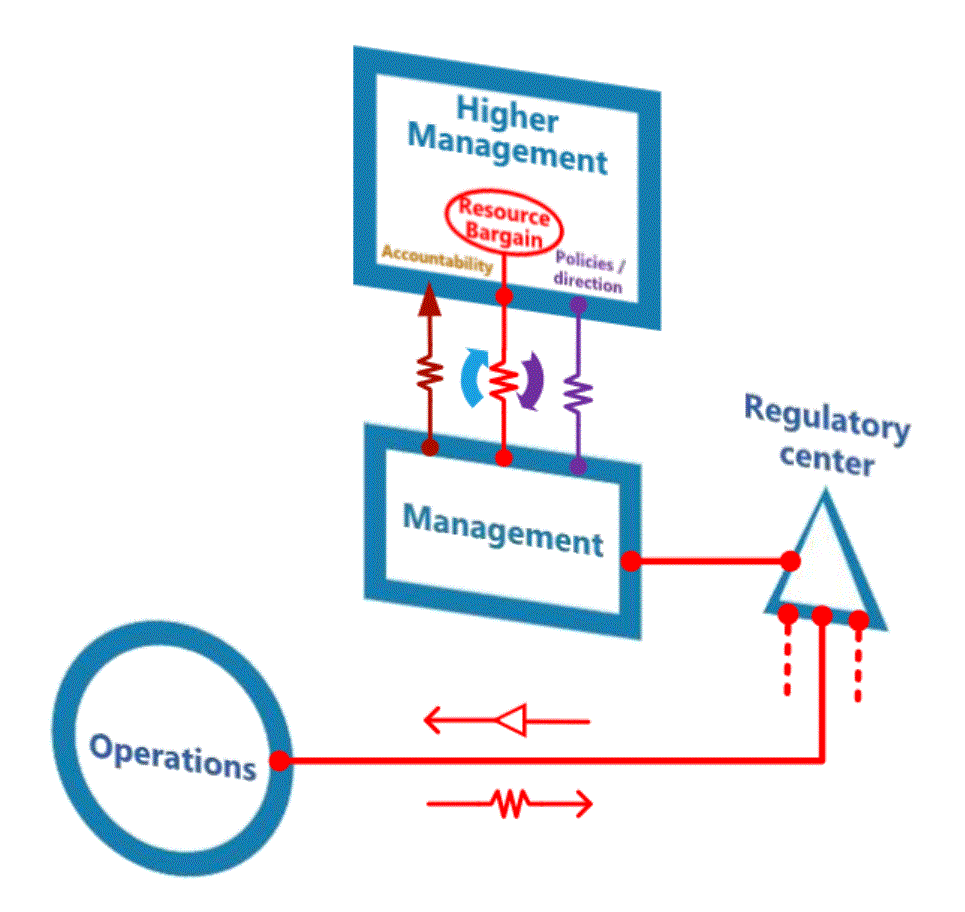
The ideas behind the model are not intuitive, and the handbook lays out a strategy to introduce its ideas within an operational context. The graphics have been updated considerably from his prior works, which introduce the model's ideas but may not reveal its nuances.
Businesses have traditionally adopted a top-down command structure and flowed down strategic plans with a cascade of instructions through the ranks; unfortunately, many of these efforts lack effective feedback or the means to exploit it when available. This structure is simply too slow and inflexible to deal with environments presenting increasing rates of change and levels of complexity. It turns out that reporting relationships matter less than understanding how the complex parts of a business fit together to form a synergistic whole.
Yet when more flexible structures are adopted to better enable autonomy, this same freedom may reduce cohesion, meaningful cooperation, and synergy, which constrain the sharing of knowledge and information necessary to respond to situations rapidly and effectively across organizational boundaries. It is not possible to share or digest enough data; leaders can only recognize patterns sufficiently within their locus of control.
In their book, Profit Beyond Measure, authors H. Thomas Johnson and Anders Broms describe how blunt our tools are when we attempt to translate goals into the actions to be taken by others:
Probably the ultimate root of the modern habit of using quantitative abstractions to represent, or stand in place of, concrete things is language, "the mode of behavioral coordination through which humans bring forth the world they create with each other thing from its context". By using words, human beings give abstract shape to the world we occupy. Language lets human being separate a particular thing from its context. Formulated in a phrase, a tangible thing can then be analyzed intellectually, as if it existed apart from its physical context in the real world. Because of language, ?there is no limit to what we can describe, imagine, and relate [as mental abstractions]".
Since language allows humans to objectify and depersonalize particular things, its power is formidable. When we use language to create abstractions and to generalize, we remove and separate particular things from their context and treat them as if they were not part of a pattern in a living system. Thus, the first use of a simple word as "tree" begins to separate us from the natural habitat we share with other living beings. Once we objectify "tree? with a word we stop living among the lungs of the earth in the wild, and begin to see trees as the source of results such as fruit, shelter, tools, transportation, shade, decoration, wind barrier, writing surfaces and toilet paper. By the twentieth century, trees, almost extinct as species, became a harvestable crop in tree farms, where the primary result is to maximize the projection of "fiber" for industrial and management purposes. Thus, managing by result - managing to secure a "sustainable" supply of fiber- subject to the the web of relationships in the natural forest system to the stresses and strains of clear cutting, thereby threatening the long term viability of the natural system.
In the same way that language lets us think abstractly about fiber and trees, language also allows us to treat the abstract concept of the business result as if it were an actual object that existed separately from the messy, organizational context which gives rise to it. Viewed as an independent entity, this abstraction, this quantifiable business result that we entertain only in our minds, seems to be more real and concrete than does the real situation from which it emanated in the first place.
It is not a great leap, then, from seeing abstract results as concrete realities, to trying to manage them by arbitrarily manipulating the relationships from which they emanate. Such manipulation involves separating ends from means, or goals from the acts that achieve them. In Western culture the separation of means (the way our goal was achieved) from ends (the goal or what is to be achieved) has often been accompanied by a belief that the end or goal is immutable and prominent, and the means are ephemeral and changing. Therefore ends seem more "real" and more "valuable" than the means.
The underlying elements described by Beer are collectively holistic and autonomic. Small businesses may exhibit these functions with direct reporting relationships with the owner, whereas in large organizations they may require examination of organization charts with titles and responsibilities to discern their interrelationships.
Key concepts
Variety
In cybernetics, the number of distinguishable items (or distinguishable states of some item) is called the “variety’. So we may sum up by saying that the output variety must (at least) match the input variety for the system as a whole and for the input arrangement and the output arrangement considered separately. This is a vitally important application of Ashby’s Law of Requisite Variety, which says that control can be obtained only if the variety of the controller (and in this case of all the parts of the controller) is at least as great as the variety of the situation to be controlled. This, like all profound statements of natural law, is perfectly obvious once it has been pointed out.
There is no great difficulty, however, in finding examples of attempted control systems which disobey this law quite flagrantly, and therefore do not succeed. From traffic control to the control of the national economy, this fallacy is apparent; indeed, this is one of the key problems of control in a firm. For management always hopes to devise systems that are simple and cheap, but often ends up by spending vast sums of money to inject requisite variety which should have been designed into the system in the first place.
Multinodes
We claim we know how the whole thing works. The problem is to make it work more quickly. That must surely mean the introduction of discipline and order, of some sort, into the situation. It also means, however, that no measures may be adopted which would at the same time put the remarkable freedom of action and the wonderful flexibility of the multinode in jeopardy. If people could see how to do this, without putting themselves and their organization into a straight-jacket, there is some chance that they would adopt new techniques. One method, we ought now to agree, must be excluded although it is the one method most usually attempted in practice, because no one can think of anything else. This is the method of rigorous protocol. Explicitly: it denatures the system itself - with all its in-built capacity to generate the right answers.
The first difficulty is to know what kind of problem the multinode actually solves. It does not devote itself, its seniority and power, to the determination of trivial outcomes or it ought not to do so. It is likely to be settling a policy of great importance and therefore considerable complexity. Thus it is that people think of thinking as a process of synthesizing an integral but elaborate conclusion from a large number of component parts. The decision is seen as a rococo edifice built up clause by legal clause. This is perhaps why there are endless drafting problems facing anyone trying to promulgate an agreed decision.
The cybernetician adopts the contrary position. The output of the thinking process, the decision, has the following form: do this (rather than anything else). When the process of thinking originally starts, the multinode is faced not indeed with a number of building bricks in an edifice but with a seemingly infinite number of possible outcomes between which it must choose. It is the existence of this plethora of possibilities that cries out for decision in the first place. Then, under this model, the process we seek to assist is one of chopping down ambiguities and uncertainties until we may say: do this. In short, we would like to measure the variety of the complex decision at the start, measure the reduction of variety brought about by each conclusion reached in the process of thinking things out, and in general monitor the entire operation of the multinode as the variety comes down to a value of the decision itself. To do this we shall need two tools: a paradigm of logical search, and an actual metric - a rule and a scale - for measuring uncertainty.
Viability
An organization is viable if it can survive in a particular sort of environment.
When people refer to the firm, or any other institution, as ‘viable’, they are often referring to economic viability. From this preoccupation with the economic dimension stems the assumption that most of our problems are economic too.
Solvency, it is true, is a prerequisite of business activity- to trade while insolvent is illegal. Profitability, too, is a prerequisite- lack of business confidence is not illegal, but it is lethal. So these affairs are of primary concern. But they do not (as many suppose) constitute the goals of the enterprise. Rather are they the constraints under which it operates. So of course the regulation of cash-flow (for example) is an important managerial concern. And of course profit-consciousness in the private sector, or the consciousness of social benefit in the public sector, has to apply to expenditure; and proper returns on capital are required.
However: the tendency in ‘the city’, and among financial journalists, to treat all this as the essence of viability, is to mistake the epiphenomena of the system - the appearances and flurries of activity that prove it is actually there- for the system itself. Which of the firm’s workers, or even middle-managers, could recognize the old place by its indices of ROI, P/E ratios, and the rest? These things are abstractions, and very useful ones too, if we want to manipulate successfully our economic constraints.
Requisite variety
A measure of the complexity with which management has to deal.
You may well say that the number of possible states in a complicated entrepreneurial system is not precisely countable. That is surely correct. However, it is countable in principle: it is therefore amenable to the making of comparative statements (this has more variety than that), and to the arithmetic of ordinal numbers (this product is the fifth most profitable).
Resource bargains
The Resource Bargain is the ‘deal’ by which some degree of autonomy is agreed between the Senior Management and its junior counterparts. The bargain declares: out of all the activities that System One elements might undertake, THESE will be tackled (and not those), and the resources negotiated to these ends will be provided.
Principles of organization
Managerial, operational, and environmental varieties diffusing through an institutional system tend to equate; they should be designed to do so with minimal damage to the people and to cost
The four directional channels carrying information between the management unit, the operation, and the environment must each have a higher capacity to transmit a given amount of information relevant to variety; selection in a given time than the originating subsystem has to generate it in that time.
Wherever the information carried on a channel capable of distinguishing a given variety crosses a boundary, it undergoes transduction; the variety of the transducer must be at least equivalent to the variety of the channel.
The operation of the first three principles must be cyclically maintained through time without hiatus or lags
Two aphorisms
It is not necessary to understand the workings of a black box to understand the nature of the function it performs.
It is not necessary to understand the workings of a black box to calculate the variety that it potentially may generate.
Axioms
The sum of horizontal variety disposed by n operational elements (systems one) equals the sum of the vertical variety disposed by the six vertical components of corporate cohesion. (The six are from Environment, System Three*, the System Ones, System Two, System Three and Algedonic alerts.)
The variety disposed by System Three resulting from the operation of the First Axiom equals the variety disposed by System Four.
The variety disposed by System Five equals the residual variety generated by the operation of the Second Axiom.
System types
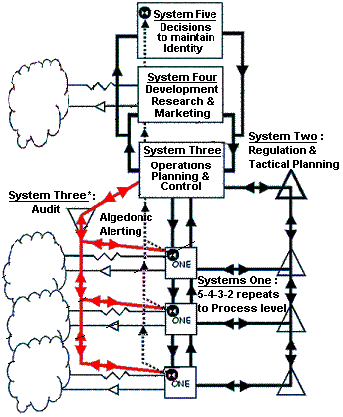
Using the architecture of the human cortex as a pattern, diverse range of specialization structures and backgrounds, and weave them into an ability to mitigate the constraints of bounded rationality, and getting reliable results out of unreliable components, especially under conditions of high uncertainty and complexity, by provide redundant inputs and assuring timely closure in decision-making processes.
What is the purpose?
What is the direction?
The types are numbered, with lower level (higher numbered) systems using algedonic signals to ‘wake up’ higher systems. Investments are used as variety attenuators.
Multiple 3-2-1 systems operate as peers (and on a traditional organization, would be depicted horizontally), providing separate functions, such as engineering, marketing, production,
Performance components
System 1 - Processes
The primary purpose of system 1 is to sense and make sense of what has been sensed in order to do something that will be rewarded by its environment. Operations are managed through a regulatory center, which fans out its inputs to a variety of measuring points, which are incapable of measuring everything. The overall processes must establish:
What activities are to be done?
What resources are to be allocated to perform these activities?
Who will be held accountable if resource bargains are broken?
How will operational exceptions be managed, whether to triage issues or adjust behaviors?
How will business opportunities be sanctioned and managed?
System 2 - Coordination & Orchestration
System 1 activities may get in each other’s way. This can cause oscillations that result from unconstrained schedule glitches, budget disruptions and problems with enabling infrastructure. Operational units should comply with the various policies and standards, not because they are ordered to do so, but because they offer tangible benefits/control/cohesion, resource management, performance management, compliance management, monitoring/audit, or coordination.
Iterations clarify:
How is coordination or orchestration provided appropriate to the situation?
What protocols must each multinode perform to support the higher regulatory authority?
System 3 - Internal monitoring and control
This requires self-organization and autonomic regulation, making inside and now decisions across the collection of System 1 activities within their emerging situation, allocating time, money, space and attention. It also must clean up excess variety that that falls through the cracks of regular arrangements.
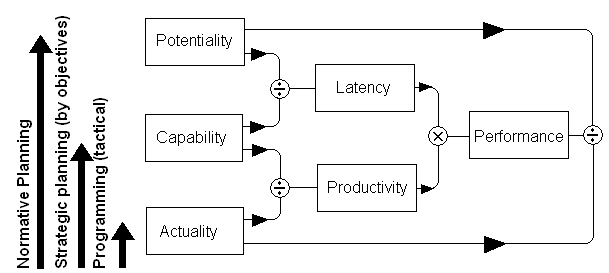
If things go wrong and levels of risk increase the System 3 asks for help or puts it to colleagues for a remedy. This is the pain of an algedonic alert, which can be automatic when performance fails to achieve capability targets. The autonomic 3?2?1 homeostatic loop's problem is absorbed for a solution within the autonomy of its metasystem.
Measurements are used to match people, machines, and money to jobs that produce useful products or services. In a set of processes, some jobs are done by one person. Some are done by many and often many processes are done by the same person. Throughout the working day a participant, in completing a task, may find the focus shifts between internal and external Systems 1?5 from moment to moment.
The choices, or decisions discriminated against, and their cost (or effort) defines the variety and hence resources needed for the job. The processes (Systems 1) are operationally managed by System 3 by monitoring performance and assuring (System 2) the flow of product between System 1s and out to users.
System 3 is able to audit (via 3*) past performance so "bad times" for production can be compared to "good times". If things go wrong and levels of risk increase the System 3 asks for help or puts it to colleagues for a remedy.
Whilst specialist groups may be used to help provide focus and impetus for the functions of System 4, they should be augmented by a range of integrative mechanisms to align the separate narratives competing for attention.
Includes additional feedback on the true state of operations across the business entities. via independent audits. they must be sporadic and infrequent, since routine audits relinquish much of the variety they generate.? Second, they must be openly declared mechanisms to avoid concerns about excessive corporate control.? Third, they must only link two adjacent levels of recursion to avoid a breakdown in trust or an overload of unnecessary information.
How are activities to be defined, managed and monitored?
How will assurance activities be used to verify performance?
System 4 - Outside and future
The Intelligence function is the two-way link between the primary activity (ie. Viable System) and its external environment. Intelligence is fundamental to adaptivity; firstly, it provides the primary activity with continuous feedback on marketplace conditions, technology changes and all external factors that are likely to be relevant to it in the future; secondly, it projects the identity and message of the organization into its environment. These loops must operate in balance, to avoid either overloading the system with a swamp of external research data without the capacity to interpret and act on that data; or the alternative risk of communicating outwards in a strong fashion, without having a corresponding means to listen for feedback from the marketplace.? The intelligence function is strongly future-focused. It is concerned with planning the way ahead in the light of external environmental changes and internal organizational capabilities so that the organization can invent its own future (as opposed to being controlled by the environment). To ensure that its plans are well-grounded in an accurate appreciation of the current organizational context, the intelligence function also needs to have at its disposal an up-to-date model of the organization.
The Intelligence function is the two-way link between the primary activity (ie. Viable System) and its external environment. Intelligence is fundamental to adaptivity; firstly, it provides the primary activity with continuous feedback on marketplace conditions, technology changes and all external factors that are likely to be relevant to it in the future; secondly, it projects the identity and message of the organization into its environment. These loops must operate in balance, to avoid either overloading the system with a swamp of external research data without the capacity to interpret and act on that data; or the alternative risk of communicating outwards in a strong fashion, without having a corresponding means to listen for feedback from the marketplace.? The intelligence function is strongly future-focused. It is concerned with planning the way ahead in the light of external environmental changes and internal organizational capabilities so that the organization can invent its own future (as opposed to being controlled by the environment). To ensure that its plans are well-grounded in an accurate appreciation of the current organizational context, the intelligence function also needs to have at its disposal an up-to-date model of the organization.
Pattern recognition in chess is possible without considering and grading every possible move. A filter should be used that can exploit pattern recognition capable of recognizing patterns in the developing, imminent future. It must acquire relevant criteria from knowledge about the rules (or corporate ethos). The typical strategy one adopts until a depth picture emerges is to strengthen oneself. Remember the decision not to act is a current action.
System 5 - Identity and policy
The last function, giving closure to the system as a whole, is the policy-making function. This function is by definition low-variety (in comparison with the complexity of the rest of the organizational unit and the even larger complexity of the surrounding environment); it, therefore, needs to be highly selective in the information it receives. This selectivity is largely achieved through the activities and interactions of the Intelligence and Control functions.? The main roles of Policy are to provide clarity about the overall direction, values, and purpose of the organizational unit, and to design, at the highest level, the conditions for organizational effectiveness.