

A capability is a solution to a problem needed for a job. Technically, it is that which provides an ability to achieve a desired effect under specified standards and conditions. Such effects must be observable, such as through changes in the resources produced and consumed in performing an activity. Endeavors shape courses of action which define the structure for pursuing goals and - in concert with others - contribute to making the world a better place.
Different architectural frameworks have different interpretations of the underlying concept of capabilities themselves. For example, the TOGAF framework uses the word to delineate business capabilities for architectures without prescribing how such capabilities might be achieved. The framework uses the concept of 'capability increments' as building blocks that are essential to capability planning, but remains silent about the means of developing, enhancing, and delivering the necessary capabilities, expecting such methods to emerge from someone’s service offering. As a result, when underlying governance associated with governance is limited, ambiguous, or inconsistently applied, it can prove difficult to diagnose and resolve problems of performance which may be hidden by the abstract idea of a capability itself.
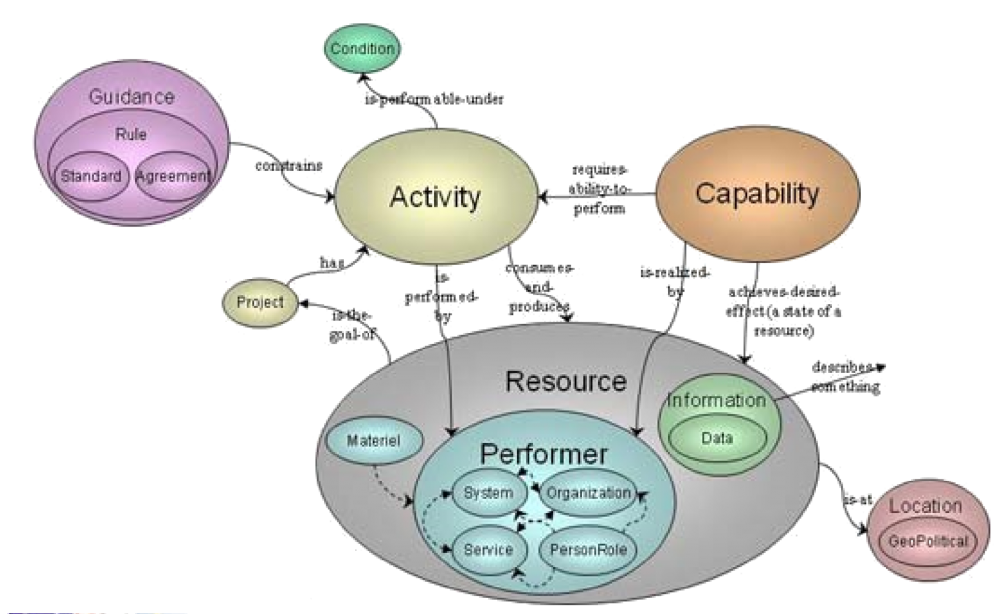
In contrast, the DODAF framework adopts a more specific meaning for the concept of a capability - that depicted in figure 1. This representation is notable in its modeling of resources as abstractions of information, material, and performers. Not to get too philosophical here, but effective considerations of architectures that promise enabling, enhancing, or extending underlying capabilities must be grounded in an understanding of the various systems of interest's variety, pragmatics, and mereology, as well as the praxis of its production. Such an analysis is far more complicated than Figure 1 implies and is described below:
Capabilities are enacted by agents who perform activities which consume materiel, resources, and time in order to transformations. These agents require a complicated mix of systems, services, and resources to achieve the desired effect.
Agents are expected to comply with guidance enabling them to competently perform these activities and produce acceptable outcomes under specified conditions. Such guidance typically introduces constraints which attempt to limit anomalous behavior. This guidance is provided in many forms, such as rules, standards, and agreements.
The essence of capabilities
Capabilities build upon actionable competencies that an endeavor must possess to operate effectively. They are:
Concrete enablers of performance
Stable over time, even as processes or org charts shift
Composable, forming higher‑order capabilities through integration
Evaluable, meaning you can assess maturity, sufficiency, or gaps
Interdependent, but in a more operational than metaphysical sense
In short: Capabilities describe what an endeavor must be able to do reliably.
Information and competency are essential ingredients for performing these activities in each unique context. Unfortunately, performers are often expected to achieve target outcomes under conditions that are less than ideal. For example, agents may have little precedent or practical experience base to draw upon. Such conditions will impact the achievement of the target outcomes, even though such situations may not be immediately apparent. When flexibility is available which tolerates cycles of iteration to achieve these outcomes, progress can still be achieved, though performance may disappoint.
Adaptation
Modeling of a capability’s evolution over time - strategically, tactically, and operationally - should synthesize information from available sources and present it in a form suitable for use by its agents. Viewpoints produce thematic collections of this information that focus attention on their particular areas of concerns, incorporating relevant architectural data using combinations of diagrams, pictures, narrative text, matrices, tables, and dashboards.
Since this information is essential to shaping capabilities and optimizing resources over time, these viewpoints can facilitate decisions to minimize rework across the broader communities of interest of these agents. These viewpoint definitions should highlight the entities each capabilities produce and consume and must be adequate to realize coherent and effective operations across all performers engaging with the capability overall.
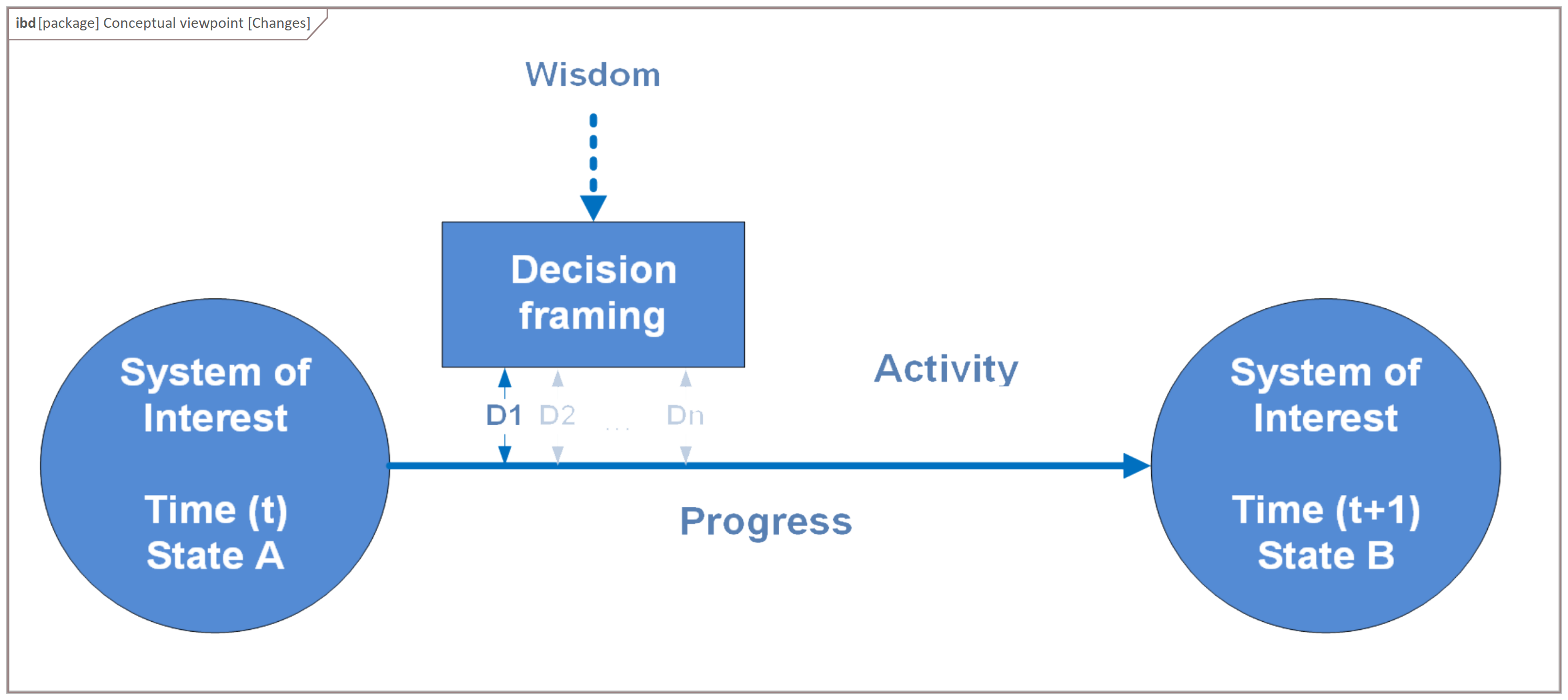
Changes (as shown in Figure 2) are ever-present in the pursuit of each capability's target outcomes. Such changes include intentional modifications to a system of interest's state that result from informed decisions, changes introduced by the environment, and changes necessary to correct or adjust some limitation in the system. In each of these situations, system of interest transitions from one configuration to another through transforming activities which realize this state change over time. Progress for a capability is demonstrated by assuring that the value accessible from the systems of interest is greater in State B than in State A.
The resources necessary to effect such changes and exploit a capability depend upon many factors, including the environment, the fitness and stability of the systems of interest, and the scenarios under which value can be extracted. This is particularly relevant when a capability's evolution requires changes to the beliefs and values of the performers themselves. Their emotional and cognitive needs are of particular concern since they will be expected to diagnose unfamiliar situations, properly infer meaning from these situations, formulate appropriate intentions in response, and translate those intentions into meaningful and appropriate courses of action. The unfortunate alternative is to abandon the intended purposes of required capabilities and live with the consequences.