
A Production Operating System
Every system is perfectly designed to get the results it gets - W. Edwards Deming

The essence of Operational Excellence
Operational excellence is not a single methodology or a set of best practices; it’s a discipline of coherence: the ongoing ability of an endeavor to align intent, capability, and execution so that work flows smoothly from concept to completion. At its core, operational excellence depends on three things:
Clarity of purpose (what the system is trying to achieve)
Visibility of work (how value is actually produced)
Coherence of behaviors (how agents act within the system)
When these elements reinforce each other, endeavors develop a kind of operational gravity: work moves in the right direction with less friction, fewer surprises, and more resilience. But this gravity only emerges when the underlying orientations of the people doing the work are recognized and integrated rather than left to operate in isolation.
The Role of Agent Orientations
Every agent in a system operates from a viewpoint. Some are Process‑oriented, optimizing flow and reducing variation. Others are Insight‑oriented, probing for meaning, patterns, and strategic leverage. Still others are Action‑oriented, driving momentum and execution. These orientations are inherent to how agents approach complex work.
Operational excellence emerges when these orientations are deliberately orchestrated. A system that overweighs process becomes rigid. One that overweighs insight becomes paralyzed by analysis. One that overweighs action becomes chaotic. The craft of operational leadership lies in creating a work operating system where each orientation plays its role without dominating the others.
The Pitfalls That Undermine Operational Excellence
Most endeavors don’t fail because they lack intelligence or effort. They fail because they fall into predictable traps. Some of the most common include:
1. The Illusion of Alignment
Teams often believe they share a common understanding of goals, constraints, and priorities. In reality, each orientation interprets the mission differently. Without explicit alignment rituals, these differences compound into drift, rework, and conflict.
2. Process Overreach
In the name of efficiency, organizations often add layers of process that obscure rather than illuminate the work. This creates a brittle system where compliance replaces judgment and where deviations (often the source of innovation) are treated as defects.
3. Invisible Work and Hidden Queues
When work is not made visible, bottlenecks form silently. People optimize locally, unaware of the system‑level consequences. Operational excellence requires exposing the true shape of work, even when that visibility is uncomfortable.
4. Over‑reliance on Heroics
High performers can temporarily mask systemic flaws, but heroics are not scalable. Systems that depend on exceptional individuals inevitably collapse under load. Excellence comes from designing systems where ordinary performance reliably produces extraordinary outcomes.
5. Fragmented Feedback Loops
When insights from the front lines don’t reach decision‑makers—or when decisions don’t translate into operational behavior—the system loses its ability to learn. Excellence requires tight, bidirectional feedback loops that connect strategy to execution.
6. External perturbations
Changes are inevitable, and the dynamics they generate amplify the effort required to resolve known problems and obfuscate the clarity of purpose essential for coherence.
The Real Work: Integrating Perspectives Into a Coherent System
Operational excellence is ultimately a systems integration problem. It requires building a work operating system where:
Strategy is translated into actionable constraints
Processes are designed to support - not constrain - human judgment
Insights flow freely across boundaries
Execution is measured in terms of outcomes, not activity
Agents understand not just their role, but how their orientation contributes to the whole
This is why operational excellence is so difficult: it demands continuous negotiation between competing goods; efficiency vs. adaptability; standardization vs. autonomy; speed vs. quality. The organizations that excel are those that treat these tensions not as problems to eliminate but as dynamics to manage.
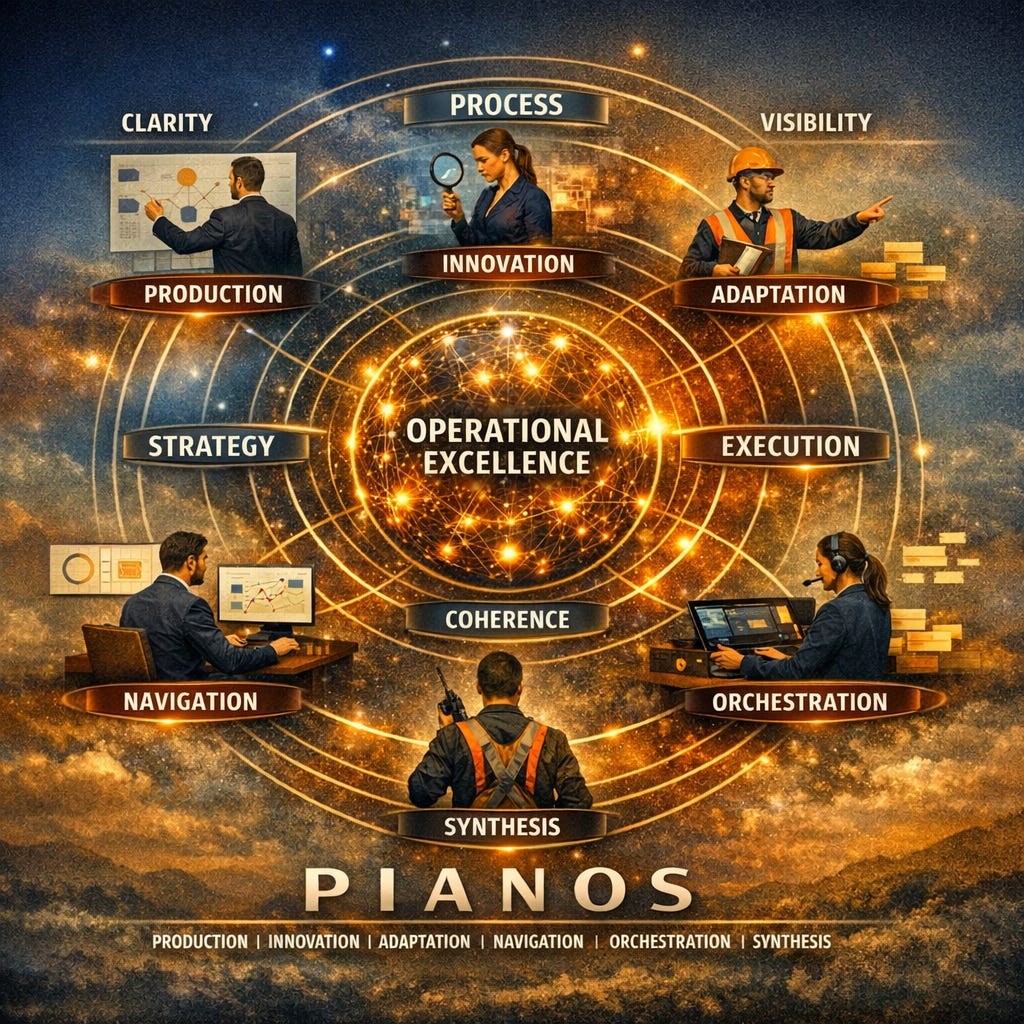
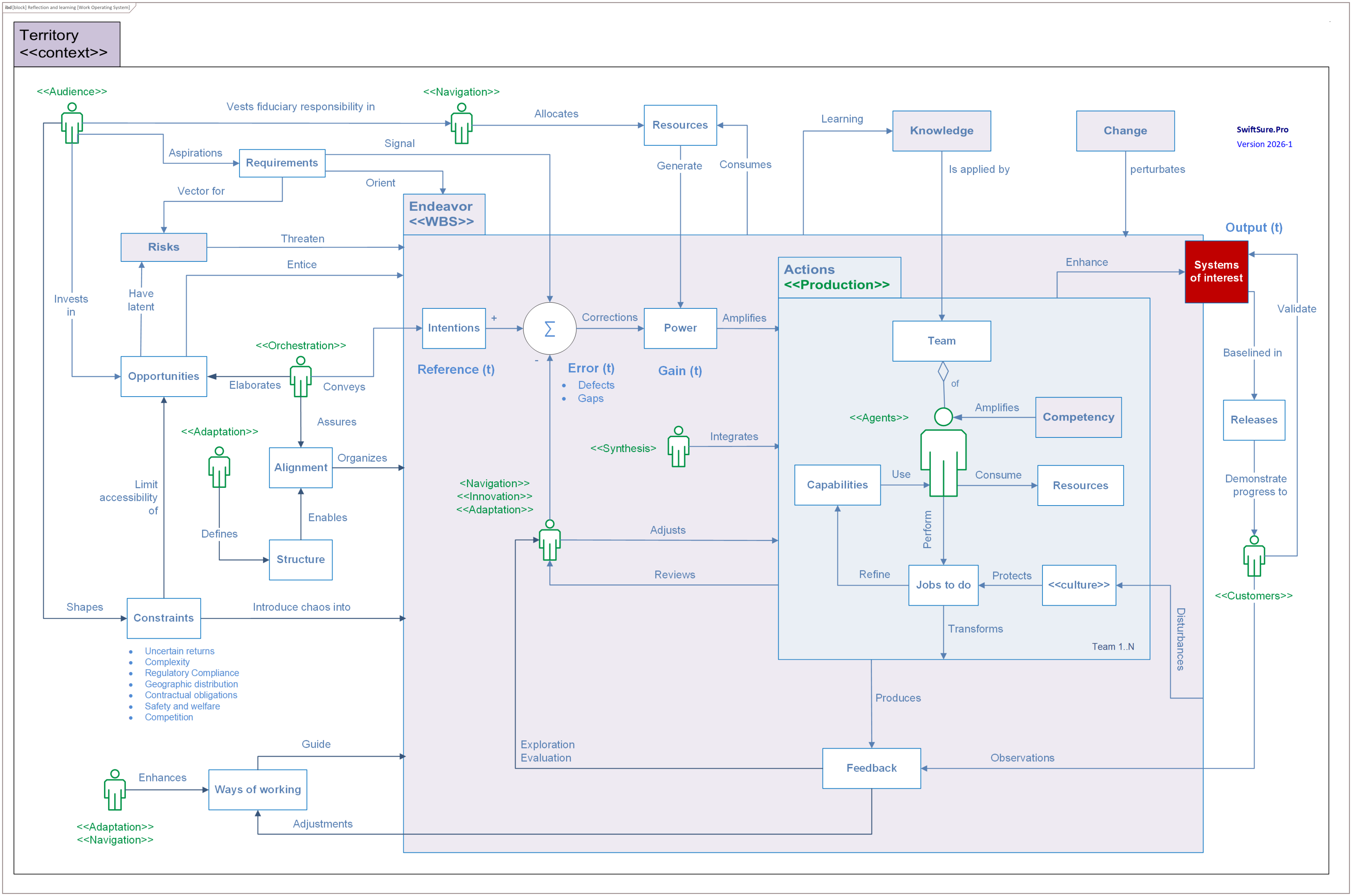
The PIANOS model exposes these viewpoints and operates within a macro-level flow depicted in Figure 2:
A narrative of these viewpoints in action
Here lies the Territory occupied by endeavors pursuing excellence. Its aspirations are charted as requirements, the sacred pact made among team members and the endeavor’s stakeholders. The endeavor’s Audience - the sum of all our stakeholders, vests a Navigator role with fiduciary trust, expecting that the stakeholder’s needs and intentions will stand as the blueprint for endeavors as they unfold. The interactions with this Audience often shape risk profiles, priorities, and cultural dynamics.
Yet in every endeavor, risks lurk - wily shadows that threaten our course and anticipate unforeseen detours. Opposite them, opportunities wait in latent promise, ready to be elaborated by those daring enough to shoulder the inevitable responsibilities. Navigation allocates resources to fuel learning and knowledge capture which provide a foundation for improvements that will stick. Despite this knowledge, the impacts of changes continue to emerge, perturbations that nudge our venture from stillness into motion.
In parallel, Adaptation lays down Structure, carving channels for Alignment. It’s the architect of our resilience. It beckons Orchestration, that deft hand which conveys vision and assures cohesion, ensuring each resource finds its place.
Actions take form, as each team member uses their competency and capabilities to execute their Jobs to Do. These tasks are fed by ceaseless feedback loops. With each iteration, outputs materialize, as capabilities updates are deployed, releases are delivered, and customers are served.
Between each node, flawed intentions and slips also contaminate our aspirations and plans. Defects emerge as intentions falter, and power is typically pulsed to correct our course. The crucible of alignment serves to confirm that business objectives are being effectively translated into operational targets and to trigger adjustments when warranted.
Within this Territory of intentions therefore lies both our greatest potential and our most familiar pitfalls. Only by tracing these threads - and by orchestrating Adaptation and Navigation - can we shift from planning to effective transformation of intentions into impacts.